
REVIEW · JAPAN
Private Nara Tour and Sake Tasting (Departing from Kyoto/Nara)
Nara rewards early risers. This private morning outing takes you from Kintetsu-Nara Station to major temples, shrines, deer-filled park paths, and a local sake brewery before the crowds build. I especially like the efficient route and the chance to explore with a guide who can explain customs, history, and train connections. The optional sake tasting adds a pleasant local finish. The main drawback is the amount of walking, plus the extra train fare from Kyoto.
You get a lot in four to six hours: Kofuku-ji, Todai-ji, Nigatsu-do, Tamukeyama Hachimangu, Nara Park, Kasuga Grand Shrine, and Harushika Brewery. Guides such as Ikki have earned praise for clear English, patient pacing, family-friendly conversation, and taking excellent photos. Still, this is not a gentle ride between sights. You need moderate fitness, comfortable shoes, and a strict eye on the meeting time.
Key points to know before booking
- Early access to Nara’s major sights: The morning start helps you see the temples and deer before the busiest part of the day.
- A genuinely private outing: Only your own group participates, so the guide can adjust the pace for children, photo stops, and rest breaks.
- Todai-ji admission is included: The 800-yen entrance fee is covered, while other listed temple and shrine stops have no admission charge.
- Sake tasting is optional: Harushika Brewery offers tasting for 700 yen, with about 30 extra minutes needed.
- Kyoto departures cost more in transit: Public transportation from Kyoto adds 1,280 yen per person.
- Expect plenty of walking: The route covers a large part of Nara Park and its eastern temple and shrine area.
Why an early private Nara tour works so well
Nara is easy to reach from Kyoto, but it is not best understood as a quick photo stop. Its temples, shrines, park paths, and deer all spread across a wide area. A private guide helps turn that scattered collection of sights into a sensible morning.
The early timing is one of the strongest parts of the plan. Nara Park can become crowded around the most popular temple approaches, especially near the deer feeding areas and Todai-ji. Starting in the morning gives you a better chance to enjoy the setting without spending the whole visit weaving through large groups.
I also like the private format. You are not tied to the pace of strangers, and the guide can slow down for a child, stop for photographs, or point out something you would otherwise pass. Feedback about Ikki repeatedly highlights this quality. He is described as friendly, funny, patient, and attentive, with the ability to keep both a seven-year-old and a teenager interested.
The route is active but efficient. From Kyoto, the full experience lasts about six hours and includes public transportation. From Nara, it takes about four hours. Add roughly 30 minutes if you choose the sake tasting.
More Sake Tastings in Japan:
- 3-Hour Kyoto Insider Sake Brewery Tour with Tastings & Pairings
★ 5.0 · 917 reviews - Kyoto Sake Brewery & Tasting Walking Tour
★ 5.0 · 623 reviews - 1.5-Hour Kyoto Insider Sake Experience with 7 Tastings & Pairings
★ 5.0 · 297 reviews
Starting at Kintetsu-Nara Station
The tour begins and ends at Kintetsu-Nara Station, a useful location for a half-day visit. It is near public transportation, and the ending point leaves you free to have lunch, continue sightseeing, or return to Kyoto.
If you start in Kyoto, public transportation costs 1,280 yen per person. That fare is separate from the tour price, so include it when comparing the total cost. The guide can help with train navigation, and one family even received help buying an IC card. That kind of practical assistance matters if you are still getting used to Japan’s rail system.
The meeting time deserves serious attention. If you arrive late, you cannot join the tour and will not receive a refund. Build in extra time for finding the station entrance, using the restroom, and getting oriented before the scheduled start.
At the end, the guide can accompany you back toward Kyoto if you want to return right away. The tour itself concludes at Kintetsu-Nara Station, so you are not locked into another activity or a fixed lunch plan.
Kofuku-ji and the first look at Nara’s Buddhist past
The first stop is Kofuku-ji Temple, a UNESCO World Heritage site with a famous five-story pagoda. The pagoda is the second tallest in Japan, making it an immediate visual marker as you begin exploring Nara.
The stop lasts about 15 minutes, and admission is free. That short visit works as an introduction rather than a full temple study. Your guide can give you the setting and explain why Kofuku-ji matters before moving you toward the larger Todai-ji complex.
Do not expect a long museum visit here. The value is the context, the pagoda, and the opening view of Nara’s religious center. If you like architecture and Buddhist history, ask the guide questions early. Private tours are at their best when you use that access for conversation rather than simply following a script.
Todai-ji and the Great Buddha
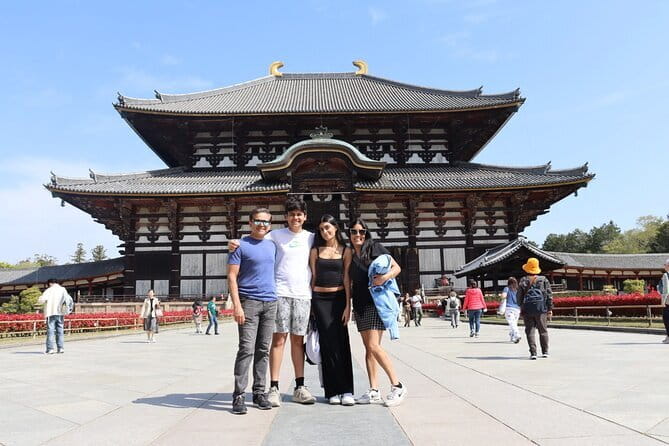
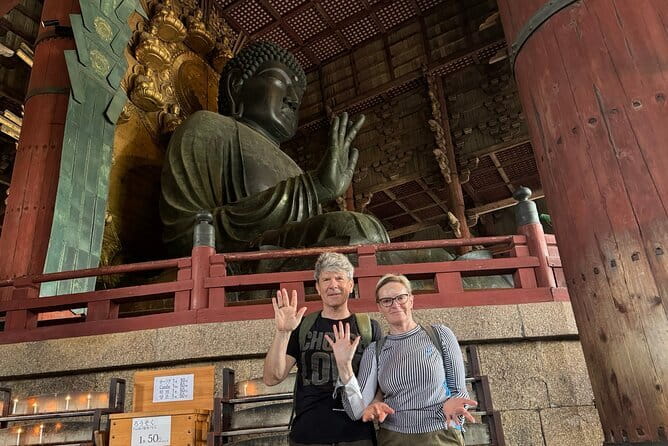
Todai-ji is the centerpiece of the morning. The temple is home to the Great Buddha, one of the largest bronze Buddha statues in the world, inside a huge wooden hall. The scale is the point. Even a short visit gives you a strong sense of why this temple is one of Japan’s best-known landmarks.
Admission is included, with the listed value of 800 yen. You spend about 30 minutes here, which is enough to enter the main hall and take in the statue, but not enough for a slow, detailed examination of every feature.
That time limit is worth noting. The guide covers a lot of ground in one morning, and Todai-ji receives only part of it. I see this as a tradeoff rather than a flaw. You get the essential experience and then move on to smaller sites that many quick visits skip.
For many people, Todai-ji will be the most memorable stop. The wooden construction, the Buddha’s size, and the surrounding temple grounds give the visit real weight. Go in ready to look up, listen, and let the scale speak for itself.
More Private Tours in Japan:
- Private Tea Ceremony and Sake Tasting in Kyoto Samurai House
★ 5.0 · 163 reviews - Private Nagano 1-Day Tour:Snow Monkeys,Zenko-ji,Obuse,Sake,Onsen
★ 5.0 · 71 reviews - Private Sake Brewery Visit and Tasting Tour in Hida
★ 5.0 · 65 reviews - Private Sake Tasting in Central Kyoto with Sake Sommelier
★ 5.0 · 32 reviews
Nigatsu-do and the view over Nara
Nigatsu-do is part of the Todai-ji complex, but it feels different from the main hall. The temple offers views across Nara and is known for Omizutori, an ancient ceremony held each March.
The ceremony has continued for more than 1,200 years and marks the arrival of spring with torch-lit rituals. Even if your visit does not take place in March, knowing this gives the wooden temple and hillside setting added meaning.
The stop lasts about 15 minutes and has no admission fee. The route to a viewpoint may feel more demanding than the time suggests, especially after walking through Todai-ji. Take your time on steps and uneven paths. You are not only visiting another building here. You are getting a different angle on Nara and a quieter pause after the Great Buddha.
Tamukeyama Hachimangu, where Buddhist and Shinto traditions meet
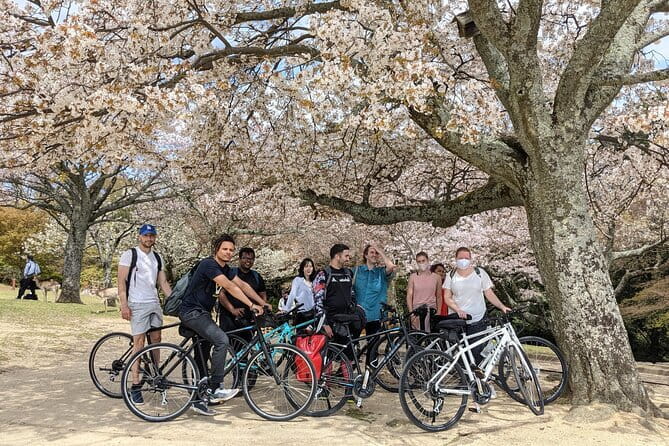
Tamukeyama Hachimangu sits on the eastern side of Nara Park near Todai-ji. Founded in 749, it was built to honor Hachiman, the guardian deity of Todai-ji.
This is a useful stop because it shows how Buddhist temples and Shinto shrines were connected in Japan’s older religious tradition. A guide can make that relationship easier to understand than a signboard alone.
The visit takes about 15 minutes and is free. It is not the biggest or most famous site on the route, but that is precisely why it earns a place here. The tour is not just a parade of headline attractions. It also makes room for a historic shrine that many independent visitors might pass.
Nara Park and the famous deer
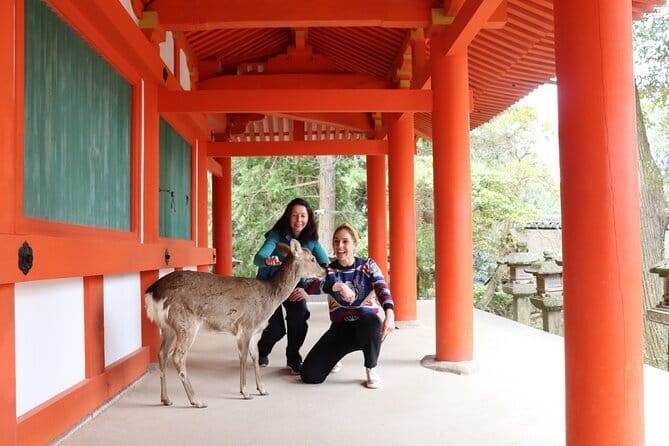
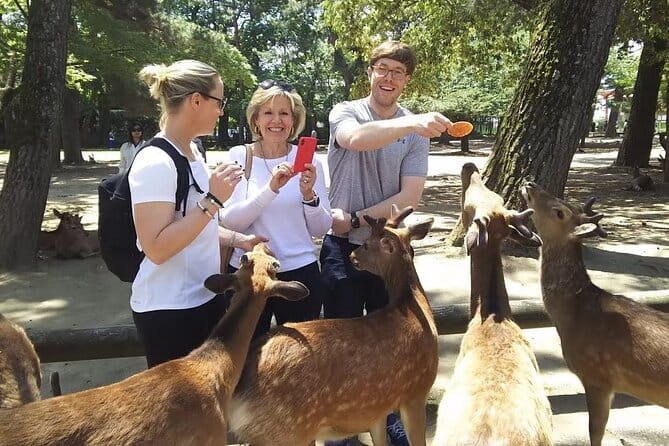
Nara Park is the most playful part of the morning. Deer move freely through the park, and you can feed them during the visit. These animals are a defining part of Nara, but you should remember that they are still animals, not decorative props.
The planned stop lasts about 20 minutes. That can pass quickly if you want photographs, especially since the guide is willing to help create them. Several guests singled out the photo help as a major benefit, including patient assistance with deer pictures and family portraits.
The deer encounter is also where guide skill matters most. A guide who knows the area can help you find good photo spots and handle the moment without turning it into a rushed feeding stop. Ikki has been praised for finding the deer, avoiding crowds, and taking a large number of photos.
Keep a little patience in reserve. The deer may approach quickly, ignore you, or focus on someone else’s food. That unpredictability is part of the fun. Your guide can help, but no one can order a deer to pose.
Kasuga Grand Shrine and its lanterns
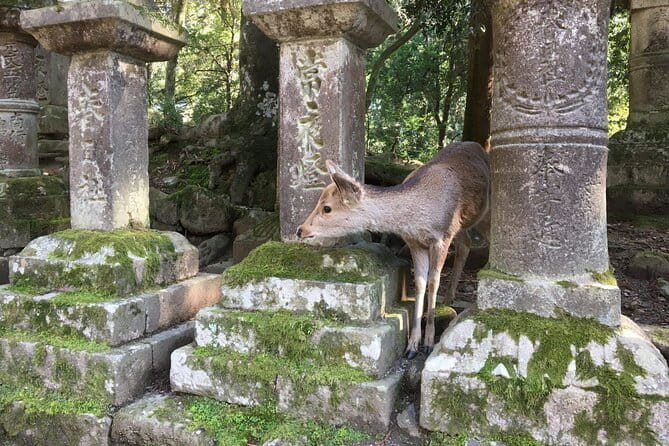
Kasuga Grand Shrine is one of Nara’s most important Shinto sites and another UNESCO World Heritage location. It is known for its many stone and bronze lanterns and is linked to the deity of the Fujiwara clan.
The visit lasts about 30 minutes and admission is listed as free. Compared with the deer stop, this section is more reflective. You move from the open park into a sacred setting shaped by lanterns, forest paths, and long religious use.
Thirty minutes gives you a useful introduction, but not a leisurely exploration of every corner. If you are especially interested in Shinto architecture or ceremonial customs, tell the guide. The private setting gives you a chance to ask for more explanation instead of accepting only a quick label.
The sequence also makes sense. After the large Buddhist buildings at Todai-ji and the playful park encounter, Kasuga Grand Shrine gives the day a quieter close to the cultural portion.
Harushika Brewery and the optional sake tasting
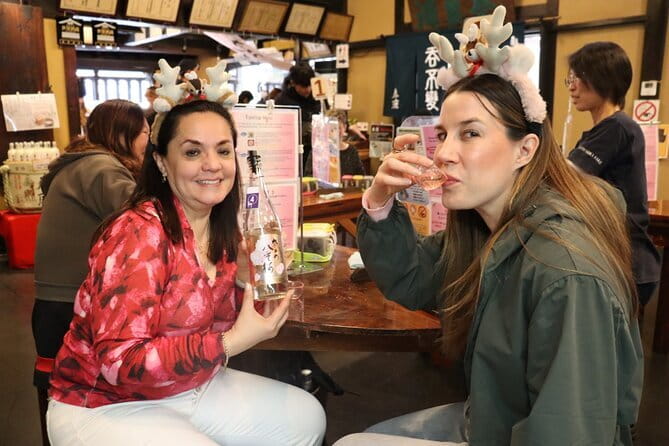
The final stop is Harushika Brewery, known for sake made by traditional methods. The sake tasting costs 700 yen per person and is optional. You should allow an extra 30 minutes if you choose it.
This is not included in the tour price, but it adds something the temples cannot: a taste of present-day local life. You can finish the morning with a drink and a better sense of how sake fits into Japanese food culture.
The optional format is sensible. Not everyone drinks alcohol, and some people would rather use the extra time for lunch or more sightseeing. If you do want to taste sake, bring the additional 700 yen and tell the guide that you plan to participate.
Because the brewery comes at the end, you are not trying to continue a long walking route afterward as part of the tour. You finish back at Kintetsu-Nara Station, with the rest of the day still open.
Walking, timing, and the real pace of the day
This is a walking tour that uses public transportation, not a vehicle-based sightseeing circuit. You should expect extended time on foot between temples, shrines, park paths, and the station.
The scheduled stops add up to about two and a half hours, before allowing for movement between them, explanations, photographs, and transportation. That is why the full experience reaches four hours from Nara and about six hours from Kyoto.
Wear shoes you trust. The tour suits people with moderate physical fitness, but the amount of walking may be tiring if you have mobility concerns or prefer slow, short outings. One useful point from the experience is that Ikki has adjusted the pace for families and allowed time to rest, linger, or shop. Since the tour is private, you can communicate your needs.
The morning plan also means you should eat something beforehand or know where you want lunch afterward. The tour ends at the station rather than including a meal.
What the $165.13 price gets you
At $165.13 per person, this is not the cheapest way to see Nara. You are paying for a private English-speaking guide, planning, local navigation, Todai-ji admission, photo help, and the ability to shape the pace around your own group.
The value improves for families or small groups that want personal attention. A guide who can help with train navigation, explain customs, answer questions, take photos, and adjust the route has more practical value than a basic walk-by tour.
You must add 1,280 yen per person for public transportation from Kyoto. Sake adds another 700 yen only if you choose it. The price may also suit you better if you are short on time and want to see Nara’s major highlights in one organized morning instead of working out the route yourself.
I would not book it solely to save money. I would book it to remove friction and get more meaning from a compact visit. The strong praise for Ikki focuses on exactly those benefits: clear explanations, good humor, patient guidance, easy conversation, and excellent photographs.
Who should book this experience?
I would recommend it to first-time visitors staying in Kyoto who want a structured Nara day without surrendering the whole day to transport and planning. It also fits families, since the private format allows the guide to keep younger children involved.
It is a good match if you want the headline sights but also appreciate smaller stops such as Tamukeyama Hachimangu and Nigatsu-do. You will get more from the morning if you enjoy asking questions about history, religion, customs, and local life.
I would be cautious if you dislike walking, need a very slow pace, or want a long, detailed visit inside each temple. The itinerary covers seven stops, so it favors range and efficiency over deep time at one place.
Free cancellation is available up to 24 hours before the start time. Changes or cancellations inside that window are not accepted, so keep the firm meeting time in mind when arranging trains.
Should you book the private Nara tour?
Book it if you want a focused, personal introduction to Nara with temples, deer, a shrine, photographs, and an optional sake tasting in one morning. The private format and early start are the strongest reasons to choose it, and Ikki’s friendly, flexible guiding has made a real difference for families and couples.
Skip it if you want to wander entirely on your own or spend hours at one site. For most visitors with limited time in Kyoto or Nara, though, the route gives you a smart first look at Japan’s first capital, with enough local help to make the day easier and more memorable.
FAQ
Where does the tour start?
The tour starts at Kintetsu-Nara Station in Nara, at 29 Higashimukinakamachi, Nara 630-8215.
Where does the tour end?
The tour ends at Kintetsu-Nara Station. You can continue sightseeing or have lunch nearby after the tour.
Can I join the tour from Kyoto?
Yes. Departures from Kyoto use public transportation, and the trip takes about six hours in total.
How long is the tour from Nara?
The experience takes about four hours when departing from Nara.
Is public transportation included from Kyoto?
No. Public transportation from Kyoto costs 1,280 yen per person and is not included.
Is the sake tasting included?
No. Sake tasting at Harushika Brewery is optional and costs 700 yen per person.
How much extra time does the sake tasting require?
Allow about 30 additional minutes if you choose the tasting.
Is Todai-ji admission included?
Yes. Entrance to Todai-ji is included. The listed admission value is 800 yen.
Is this a private tour?
Yes. Only your own group participates in the activity.
How much walking is involved?
The experience is designed as a walking tour using public transportation and time on foot. A moderate level of physical fitness is recommended.
What happens if I arrive late?
If you are late for the meeting time, you cannot join the tour and will not receive a refund.
Can I cancel for a full refund?
Yes. You can cancel at least 24 hours before the start time for a full refund. Cancellations made less than 24 hours before the experience are not refunded.
Just added around Japan
- Tokyo Sake Tasting Tour with a Sake Expert★ 5.0 · 7 reviews
- Wagyu BBQ & Sukiyaki with Sake Pairing Experience near Ginza★ 5.0 · 2 reviews
- Sake Tasting and Cherry Blossom Fun in Tokyo!★ 5.0 · 4 reviews
- Private Sake Tasting at 300 Years Old Sake Brewery in Tokyo★ 5.0 · 3 reviews
- Tokyo: Serene Sakura & Sake: An Exclusive Brewery Pairing Lunch★ 5.0 · 2 reviews
- Nagano: Snow Monkey and Zenkoji Temple Free Sake Taste Day Tour★ 4.5 · 8 reviews
- Sake Pairing Workshop with Japanese Food in Shinjuku★ 5.0 · 5 reviews
- Mt FUJI – Panoramic Tour w/ Hoto Lunch, JP Sake & Onsen tatto OK!★ 5.0 · 9 reviews
Sake Tasting, compared.
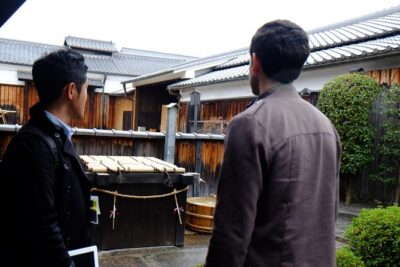
3-Hour Kyoto Insider Sake Brewery Tour with Tastings & Pairings
Read our review →
1.5-Hour Kyoto Insider Sake Experience with 7 Tastings & Pairings
Read our review →
Sake Tasting Masterclass in Shinjuku (8+ Varieties with a Pro)
Read our review →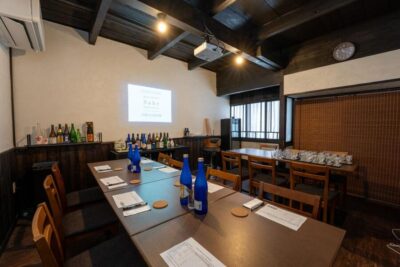
Insider Sake Experience with 7 Tastings and Snacks
Read our review →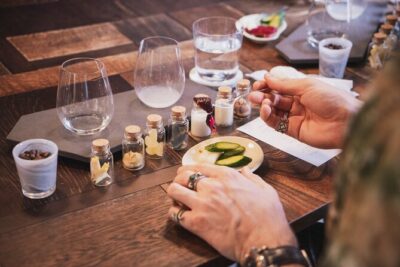
Sake Omakase in Tokyo: Guided Tasting by Certified Sommeliers
Read our review →
Private Tea Ceremony and Sake Tasting in Kyoto Samurai House
Read our review →
Casual Japanese SAKE tasting and snack experience in Kabukicho
Read our review →
Browse the lists this tour appears in